Edinburgh and Glasgow city centres are showing renewed momentum in 2026, with occupier demand for high-quality office space continuing to outstrip supply, according to the inaugural UK Regions Office Market Report 2026.
The report is produced by Lambert Smith Hampton (LSH), where Ryden provides the Scotland market intel. It highlights a growing divergence between resilient occupier demand and constrained development activity across the UK's regional office markets. While most major markets experienced subdued take-up in 2025, both Edinburgh and Glasgow have made a strong start to 2026 and are on track to surpass last year's activity levels.
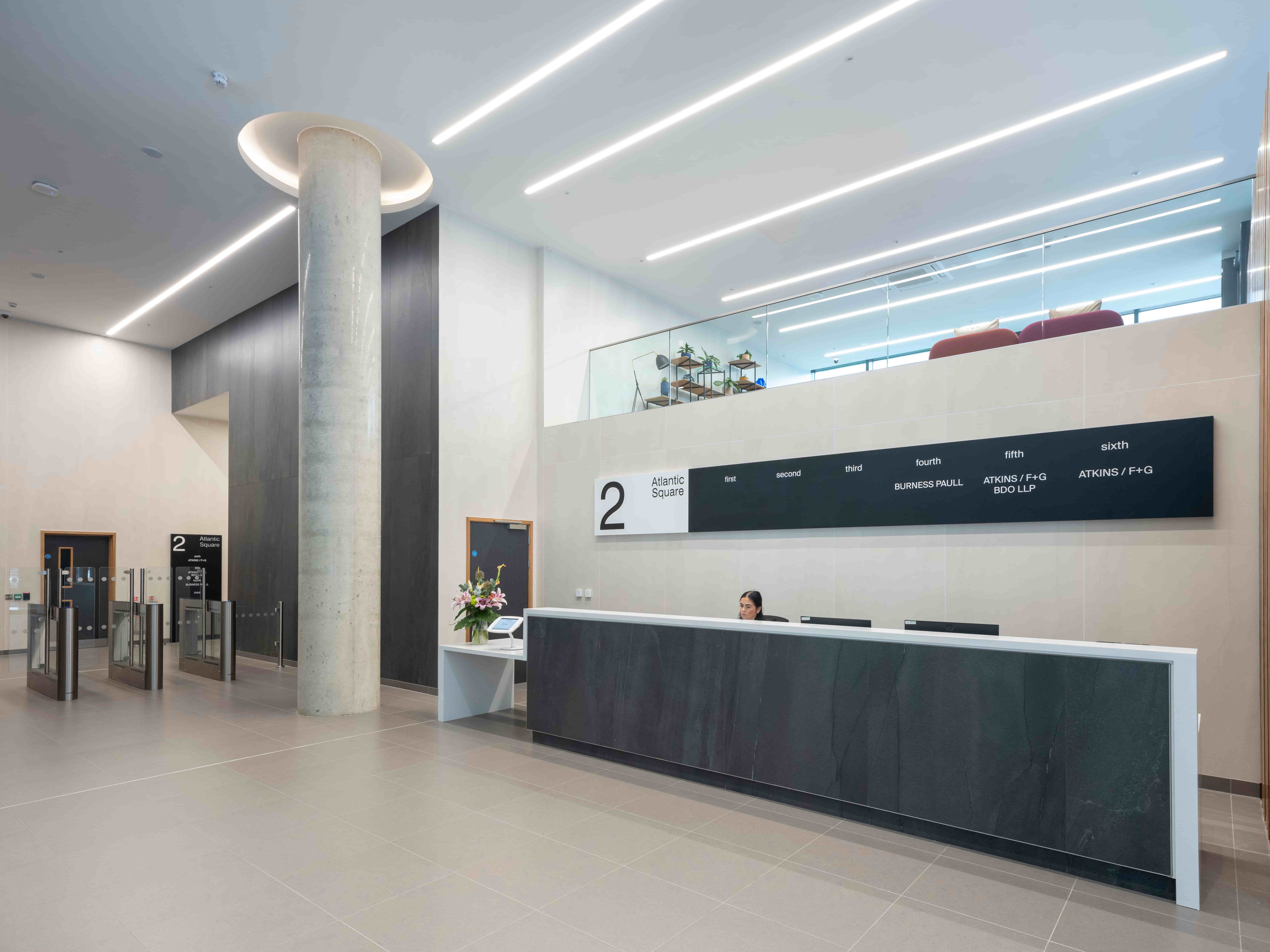
Q1 take-up for Glasgow city centre reached 131,672 sq ft, 20% above the five-year post-COVID quarterly average. This included five deals of 10,000 sq ft-plus, the largest of which was Centrica’s lease of 23,914 sq ft at 2 Atlantic Square. While most of the other larger Q1 deals were for grade B offices, a notable grade A deal saw Softcat take 10,160 sq ft at Cadworks, the last available space at the building. Activity was also brisk at the smaller end of the market, with approximately 80% of Q1’s transactions being for sub-4,000 sq ft spaces. This partly reflects continued strong demand for smaller fitted options, and 41% of all lettings completed in Q1 were delivered on either a fitted-out or turnkey basis.
In Edinburgh, Q1 2026 saw the strongest quarter in the city centre since Q4 2024, with take-up of 118,760 sq ft up 40% on Q4 2025’s total. The most significant letting in Edinburgh city centre for over 12 months came from EY’s sublease of 36,209 sq ft at 4&5 Haymarket Square (36,209 sq ft), with out highlights including Mainpoint (8,813 sq ft); Thorntons Solicitors at 65 Haymarket Terrace (6,457 sq ft); and Fairhurst at 125 Princes Street (6,064 sq ft).
The findings reveal that Edinburgh remains the tightest-supplied city centre office market among the UK's Big Six regional cities, with available stock equivalent to just 2.4 years of average annual take-up. Glasgow is also experiencing an acute shortage of prime office accommodation, with best-in-class space accounting for only 5% of total city centre availability.
This scarcity is continuing to drive rental growth. Prime rents in Edinburgh have risen 6.7% year-on-year to a peak of £48 per sq ft. Glasgow prime rents have increased by 5.1% to headline rent of £41.50 per sq ft. It is anticipated that Lucent, 50 Bothwell Street and 45 Waterloo Street will drive prime rental growth in 2026 and beyond.
Despite strong occupier demand, development activity remains limited. Across both cities, only 273,000 sq ft of refurbishment space is currently under construction, while no speculative new-build developments are underway. For example major Edinburgh schemes at Rosebery (154,071 sq ft) and New Yards at Haymarket (185,257 sq ft) are contingent on securing sizeable pre-lets before development.
Occupiers are increasingly competing for a small pool of high-quality, sustainable workspace, with many choosing to remain in existing buildings through lease regears due to the lack of suitable alternatives.
Peter I'Anson, Agency Partner at Ryden, said:
"The story across Scotland's two largest office markets is one of resilient demand meeting constrained supply. Businesses continue to prioritise high-quality, well-located workspace that supports productivity, collaboration and talent retention, but there simply isn't enough prime space available.
"Edinburgh remains one of the most tightly supplied office markets in the UK, while Glasgow is experiencing a significant shortage of best-in-class accommodation. That imbalance is driving rental growth and reinforcing the value proposition of quality office space.
"The challenge now is viability because demand is there, but development remains difficult to justify in the current economic environment. Until funding conditions improve or rents move further, refurbishment projects are likely to play a critical role in meeting occupier requirements and supporting future growth."
The report notes that occupier behaviour has largely stabilised following the pandemic, with widespread concerns of large-scale office contraction failing to materialise. Instead, demand is increasingly driven by a flight to quality, flexibility and workplace performance, supporting strong interest in premium office environments despite wider economic uncertainty.
The research forms part of Lambert Smith Hampton’s "Office Market Report 2026".